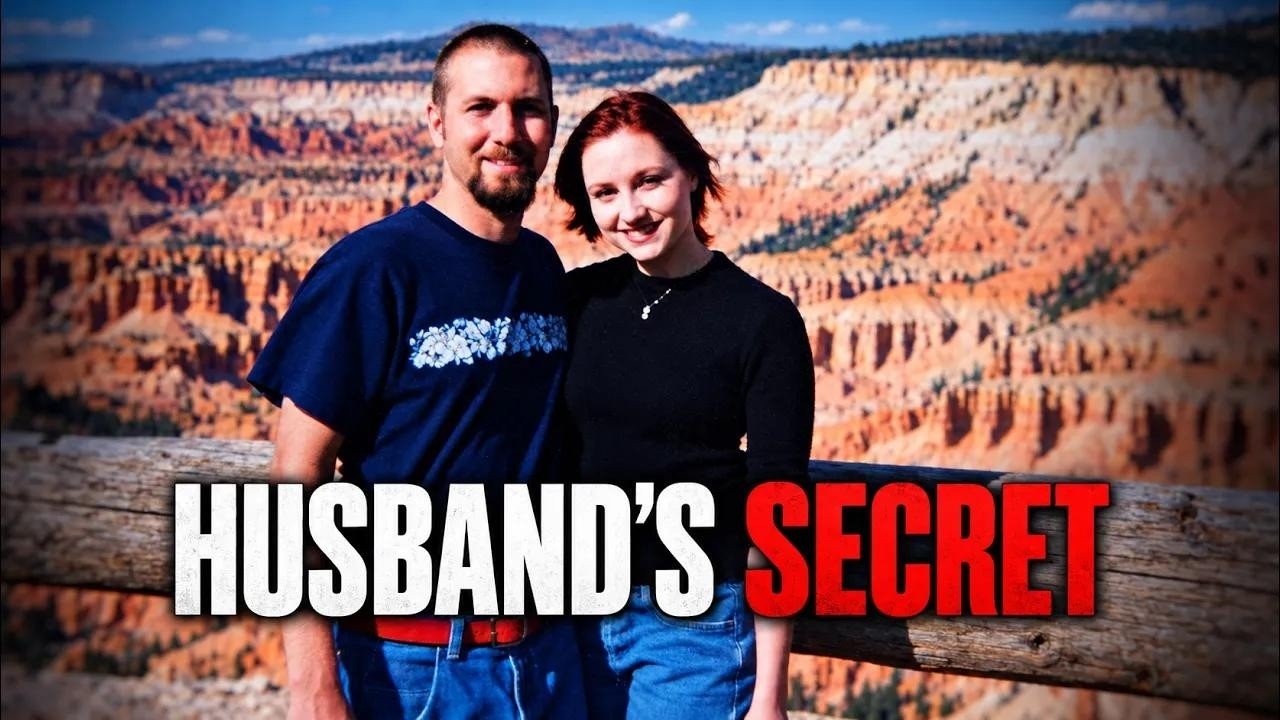
Just after 6:00 in the morning, a young couple stands on the summit of Angels Landing, one of the most dangerous trails in the United States.
On every side, the rock drops away into darkness.
The husband holds a camera.
He will later say they were waiting for the sunrise.
Minutes later, he is making his way down the trail alone.
Stopping strangers and telling them that a woman has fallen.
Not his wife, a woman.
For almost 20 years, his account of those minutes was the only one that existed.
It was accepted.
The file was closed.
A church mourned, an insurance company paid, and life moved on.
But a handful of people never let it go.
And when the questions finally returned, they brought with them a secret hidden inside a church youth group.
Life insurance policies far larger than a youth pastor's salary could explain.
And a single detail about the sky that morning that, according to investigators, could not have been true.
To understand what happened on that cliff, you first have to understand who was standing on it.
This is the story of Bernadette Vandermeer.
>> [bell] >> Unreal true crime launches its new book Unreal true crime Latin edition 35 shocking true murder cases from across Latin America.
Buy it now on Amazon.
Bernadette Marie was born on November 16th, 1977 in Phoenix, Arizona.
The younger daughter of Richard and Laura Gudenkauf.
Her older sister was named Vanessa.
Her family would describe her as a close, loving daughter and sister.
The kind of person whose presence filled the room.
By her early teens, Bernadette's life centered on a church community in Las Vegas.
At around 13 or 14, she met a youth leader named Kathy Page.
Who would remain one of her closest friends into adulthood.
To her friends, she was simply Bernie.
Page remembers an encouraging, affectionate girl who rarely spoke badly about anyone.
Music was at the center of everything.
Bernie sang in worship services.
And her ambitions went far beyond the church stage.
She wanted to become a recording artist.
It was in that same church as a teenager that she met David Howard Vandermeer.
They shared the same faith, the same community, and the same love of music.
It was the foundation of their relationship, and church would remain the center of their life together for years to come.
After high school, Bernie found work that suited a born performer.
She performed as Betty Boop at the MGM Grand in Las Vegas.
A photograph of her in costume, smiling, still survives among her family's keepsakes.
Those who worked with her described a capable entertainer and a committed worker.
The dream of a music career was still alive, and the stage, even in a cartoon costume, kept her close to it.
She also loved the outdoors.
Kathy Page would describe her as an experienced and sensible hiker.
In 1996, David brought her to Zion National Park in Southern Utah to a trail called Angel's Landing, a narrow fin of rock with sheer drops on both sides, where hikers hold on to chains anchored into the stone.
According to family accounts, it was at the summit that David proposed.
On September 28th, 1996, Bernadette and David were married.
She was 18 years old.
David built a career in ministry.
He became a youth pastor at Legacy Christian Church.
And in 2001, the couple left Legacy to help start a new congregation called New Song.
Youth ministry was not a 9-to-5 job.
It meant evenings, weekends, events, and trips with teenagers from the congregation, and Bernie's life was woven into all of it.
Meanwhile, she went to work as a cocktail server at the New York New York Hotel and Casino.
The hours were long, but the money was good.
And her income became a substantial part of the household's earnings.
In church, the couple presented an affectionate, stable image.
The young pastor and his wife who sang.
At home, according to those closest to Bernie, the picture was very different.
Her mother would later say that Bernie handed her wages and tips over to David who controlled the household spending.
Co-workers noticed that she stopped having her nails done and that she would pass on even small things.
A cheap coffee or inexpensive clothes for work despite how hard she was working.
Around 2002 or 2003, a girl of about 14 began attending David's youth group.
Court documents identify her only by her initials, S.
H.
According to her account, David gave her special attention and gifts and gradually increased physical contact.
On November 19th, 2003, Bernie wrote a document on her computer.
In it, she expressed loneliness and dissatisfaction in her marriage.
It was a private record written in her own words at a time when no one was building a case against anyone.
According to S.
H.
, by the time she was 16, the relationship with her pastor had become physical.
The court documents are not consistent about the year, pointing to 2002 in one passage and 2004 in another.
She described encounters at a cabin belonging to David's father in Brian Head, Utah, at the church, at short-stay hotels, and at an apartment he paid rent for.
She said he gave her a secret phone.
She also recalled a day when Bernie arrived at the church unexpectedly, and David told her to say he wasn't there.
David was a married adult and her pastor with authority over her.
She would also recall something he once told her, that the two of them could only be together if Bernadette was no longer alive.
On March 11th, 2005, David applied for life insurance policies of $150,000 on himself and on Bernie.
On November 28th, 2005, he increased each policy by $400,000, bringing coverage to $550,000 per spouse.
At the time, his income as a youth pastor was approximately $38,000 a year.
On March 26th, 2006, David reported his Yukon stolen.
The vehicle was recovered less than a mile from his home.
In July, Mercury Insurance paid him $46,488.
88.
Some members of the youth group found the circumstances strange.
At the time, the payout drew no official scrutiny.
That same year, Bernie wrote two letters by hand.
She described her sadness that David did not openly show her love, and that he gave other people as much attention as he gave her or more.
The letters were not addressed to the public.
They were the private words of a woman trying to make sense of a marriage that no longer felt like the one she had entered at 18.
She was also making changes.
She switched from the night shift to a daytime shift with better earnings and better hours.
And she was growing uneasy about the amount of time her husband spent with the teenagers in his youth group.
She came to suspect he was cheating.
According to her mother, Bernie confronted David and told him she wanted a divorce if things did not change.
His worry, her mother said, was how a divorce would look for a pastor.
In the summer of 2006, about a month before the anniversary trip, Bernie met Kathy Page for lunch.
She told her old friend that she believed David was being unfaithful.
And yet, there was also something to look forward to.
Their 10th wedding anniversary was approaching.
And David had planned a trip back to Zion.
Back to Angel's Landing, where he had proposed.
Until then, their trips had usually included members of the youth group.
This time, for the first time, the couple would travel alone.
Friends said Bernie was excited.
Her doubts about the marriage and her hopes for the trip existed side by side.
On the evening of Sunday, August 20th, 2006, according to SH, she ended her relationship with David.
She told him it was wrong and that she wanted to be with a young man closer to her own age.
Bernie had no idea that conversation had taken place.
The next morning, Monday, August 21st, Bernie and David left Las Vegas for Utah.
What happened on the mountain comes almost entirely from one person, David.
He was the only witness.
According to his account, the couple left their hotel in the dark and arrived at Zion at about 3:30 in the morning.
After parking, they rode bicycles to the trailhead and began climbing Angels Landing at around 4:20, lighting their way with headlamps.
At that hour, the canyon was completely dark and the narrow route climbed steadily toward the summit with long stretches where the only protection from the drop was a chain bolted into the rock.
David would later tell investigators it was Bernie's first time on this particular trail and his second.
He said they reached the summit at about 6:10.
The plan was to photograph Bernie silhouetted against the rising sun.
He took several long exposure photographs of the scenery.
Then, in his account, he noticed their backpacks were in the frame.
He moved them 5 to 10 ft away.
He turned around and heard a scream.
Bernie was gone.
He said he did not see her trip and that he heard nothing before the scream.
Bernadette VanderMeer was 28 years old.
Some later reports would say 29, but her obituary records her birth in November 1977.
At around 6:21 am, a call was placed to 911.
It dropped.
David later said poor cell coverage prevented a fuller call.
He started down the trail asking hikers for help.
One of them would recall that he He what happened as a man's wife falling without saying it was his own wife.
Another noticed a scratch or abrasion on the inside of his left forearm.
At approximately 7:46 am, 85 minutes after the first call, David reached park dispatch.
Rangers were dispatched to the canyon at 8:23 am A helicopter located Bernie's body about 1,200 ft below the summit.
It took rescuers around two more hours to reach her.
In the days that followed, David repeated his story to friends and church members.
The details did not always match.
To some youth group members, he said he had turned to get something out of his bag rather than moving the packs.
One friend remembered him saying he had heard a gasp, not a scream.
Cindy Hinch, a friend from church, heard his early explanation of the fall and, like many others, initially found comfort in it.
On August 28th, Bernie's memorial service was held.
Bernie's memorial service was held.
Hundreds of people attended.
According to SH, David asked her to join a gathering of mourners and she was there close to him.
Cathy Page noticed and was deeply troubled.
On September 15th, park ranger Tom Parrott returned to the summit with David.
The ranger descended roughly 200 ft down the cliff face.
He found only a possible impact point about 15 ft below the edge and it was inconclusive.
A second possible impact point near Bernie's body was logged but reportedly never analyzed.
In interviews, David's core account remained stable, but he denied being unfaithful to his wife.
Investigators considered the circumstances suspicious, but with no eyewitness, no conclusive physical evidence, and a limited investigation, Bernie's death was closed as an accident.
Her mother, Laura, was not satisfied.
After her daughter's death, she found additional insurance documents, and she kept asking what had really happened.
Two or three months after the memorial, according to S.
H.
, she and David resumed their sexual relationship.
On November 15th, 2006, David submitted a claim on Bernie's life insurance.
On July 10th, 2007, he received approximately $567,439.
Investigators would later say that money helped buy S.
H.
a car and a home.
People who knew David also recalled purchases and travel in the period after the payout.
Court records also list a $10,250 student loan payment and $11,732.
22 paid toward her car loan.
In 2008, David and S.
H.
were legally married, reportedly so he could be added to her employer's health insurance.
In 2010, they held a public wedding.
In the years that followed, more insurance claims surrounded David, including stolen church instruments.
Among them a drum set for which he reportedly received about $10,000.
The couple separated in 2013 and divorced in 2014.
That same year, David filed a residential burglary claim for $12,660 in property.
David moved on with his life.
He later worked as a yoga instructor and as a school counselor.
On April 6th, 2022, a former youth group member contacted authorities about David's conduct with minors and his relationship with SH.
The tip was handled as a supplemental phone interview.
According to court documents, it never received the follow-up it needed and the case went quiet again.
On October 8th, 2025, Barry Diamond, a former senior pastor and David's one-time boss, contacted the Washington County Attorney's Office.
Years earlier, Diamond had removed David from a church role after learning about gatherings involving underage members, alcohol, and gambling.
Now, nearly two decades after the fall, he told prosecutors he believed David was responsible for Bernadette's death.
This time, the tip reached someone determined to follow it all the way through.
Lieutenant Investigator Jessica Bate reopened the case.
She interviewed Diamond, former youth group members, park personnel, and other witnesses.
On December 17th, 2025, she interviewed SH, who described the years of contact with David in detail, the remark about Bernadette no longer being alive, and the conversation on the night before the trip.
She recovered Bernie's 2003 computer document and her handwritten letters.
She rebuilt the insurance timeline.
She found SH's phone number on David's AT&T account.
And she examined two things no one had looked at closely in 2006, the history of fatal falls on Angel's Landing, and the position of the sun that morning.
On June 16th, 2026, Bates signed a 17-page sworn affidavit.
Prosecutors moved to charge David with murder and insurance fraud and requested a warrant with no bail.
The affidavit laid out a theory of motive and opportunity, a hidden relationship with a young congregant, a wife who suspected him and had raised divorce, unusually large life insurance, a breakup the night before the trip, an unusual fall location, misleading statements, and a significant financial gain.
It described his actions as intentional.
On June 22nd, 2026, a fugitive task force arrested David, now 49, in the Las Vegas area.
He was held at the Clark County Detention Center while awaiting transfer to Utah.
He never arrived.
On June 24th, he was found with self-inflicted injuries, and he died in the hospital early on June 25th.
There would be no trial.
In a partially redacted handwritten note released after his death, David denied killing Bernadette.
He admitted he had been selective in describing her death because it looked bad and wrote that some of the allegations contained truth while the overall picture could lead to his conviction.
Technical analysis.
The first point is legal.
David Vandermeer was never convicted.
The affidavit presents the state's case for probable cause, not a judicial finding.
His death ended the prosecution before any evidence could be tested in court and he was never separately charged with a sexual offense over SH's account.
The most striking piece of evidence concerns the light.
On August 22nd, 2006, sunrise at Zion, calculated for a flat horizon, was 6:54 and 13 seconds.
Mountains to the east of Angels Landing would have delayed direct sunlight even further.
At the time of the first 911 call, the sun was about 7.
3° below the horizon.
A sunrise silhouette was not possible at that moment.
The limit of this evidence matters, however.
Pre-dawn twilight is not total darkness, so it undermines his stated purpose, not necessarily his ability to see.
His own long exposure photographs confirm how dark it still was, which also raises the question of how a silhouette shot could have been composed so close to the edge.
The second element is location.
Investigators mapped 17 earlier deaths on the trail.
Most accidental falls were clustered in particular sections.
Bernie fell near an unusual location for accidents in an area where several earlier deaths were suicides or considered suspicious.
With so few cases, the pattern is suggestive rather than conclusive.
It also shows why a fall at that particular spot drew attention once investigators looked back.
The physical evidence was limited.
One inconclusive impact point was found and a second was reportedly never analyzed.
The scratch on David's forearm was observed by a hiker, but never forensically examined.
The strongest material is documentary.
The insurance records, Bernie's dated writings, and the phone account.
Even here, there is a discrepancy.
David once described the policies as $600,000 each, while the itemized chronology shows $550,000.
Taken together, the evidence formed a substantial circumstantial case.
Motive, opportunity, financial benefit, and false statements.
What it could not provide was direct proof of how Bernadette left the edge.
Psychological analysis.
No diagnosis was ever made of David VanderMeer, and none can be made here.
But the behaviors described by witnesses and documents form a recognizable pattern.
The first is control.
Bernie's earnings went to David, and she stopped spending on herself.
Financial control is among the least visible forms of control in a relationship, precisely because from the outside, it can look like ordinary household management.
The second is image management.
When divorce was raised, his reported concern was appearance.
Former youth members who later lived with him described a man with a habit of offering elaborate explanations.
In his final note, he used a revealing word about his own account of Bernie's death.
Selective.
The third concerns SH.
The sequence she describes, special attention, gifts, gradually escalating contact, secrecy, and a private phone, follows a pattern that child protection professionals recognize as grooming.
It depends on trust and on an imbalance of power that a teenager cannot match.
There are also smaller signals on the trail itself.
Describing the victim as a man's wife is distancing language.
It can be a product of shock, and trauma often produces strange speech.
The shifting details of his story, a scream or a gasp, moving the packs or reaching into a bag, can also be explained by memory under stress.
On their own, none of these points prove anything.
Their weight comes from the fact that the only witness was also the person with the strongest motive.
Then there is Bernadette.
People often ask why someone in her position stays.
Her faith, her friendships, and her community were deeply tied to her husband's role as a pastor.
Leaving him meant risking almost everything she knew.
Even so, she had raised divorce, moved to a better shift, and confided in a friend.
At the same time, she looked forward to the trip.
Doubt and hope can coexist, and her writings show both.
The picture that emerges is not of a naive woman, but of someone trying in her own way to save a marriage while quietly preparing for the possibility that she could not.
The family left behind.
For Richard and Laura Goedenkauf and for Bernie's sister Vanessa, the case never truly closed in 2006.
It only went silent.
Laura found the additional insurance documents and never stopped asking questions.
When investigators returned nearly two decades later, she cooperated fully.
When David was arrested, Laura said she felt her daughter had been vindicated.
But the family also made clear that no arrest could give them real closure.
What her mother misses is not an answer.
It is Bernie herself.
Her voice, her kindness, the life she never got to finish.
Cathy Page still speaks about Bernie's generosity.
Friends from church and former co-workers said the same thing once the case reopened.
Many of them had doubts from the very beginning.
For years, they simply had nowhere to take them.
When the case reopened, those old doubts finally became statements in an investigator's file.
And the central question remains.
Did Bernadette Vandermeer slip in the pre-dawn dark as her husband always said? Or did something else happen at the edge of Angel's Landing? The courtroom that should have answered that question never opened and the answer may now be lost forever.
What do you believe happened on that summit? Tell us in the comments.
And if this case stayed with you, subscribe and turn on notifications for the next story.
>>