Part 3
And untied her apron.
Caleb’s heart sank. She’s quitting.
But Hannah just shook the apron out. Retied it tighter.
And pulled out a fresh sheet of paper.
“We’re not done,” she said. “We’re just changing the menu.”
The room went still.
“Lou, saddle a horse. Ride the high road to the church in Red Creek. Ask if they can spare flour and vegetables.”
“What do we offer in return?” Caleb asked.
“Tell them I’ll cook their winter charity dinner. At cost.”
She was already crossing things off and writing new ones.
“Fewer pies, more stew. Stew stretches. Potatoes stretch. Bread stretches if you know how.”
By evening, two farmers arrived with wagons full of potatoes and carrots.
Then a group from the church came through the mud. With flour. Butter. And six extra pairs of hands.
By midnight, the kitchen was packed and bustling.
Grace fell asleep on a bench with her mother’s cardigan folded under her head.
Noah slept in their little room, his wooden horse tucked beside him.
Caleb carried sacks. Chopped vegetables. Scrubbed pots until his hands were raw.
Just before dawn, he found Hannah alone at the stove.
Her face was pale. And a single tear was sliding down her cheek.
She wiped it away fast when she saw him.
“Are you all right?” he asked.
She was quiet a long moment.
“I’m scared,” she admitted. “For a whole year, I’ve hidden how scared I am from my children. And now everyone here is trusting me. What if I let them all down?”
Her voice broke.
“Before Thomas died, I promised him I’d give our children a safe home. Some nights, I don’t know if I have enough strength left to keep that promise.”
Caleb didn’t give her an easy answer.
He knew promises could hurt when life made them hard to keep.
“Your children don’t need a mother who can stop every hard thing from happening,” he said gently. “They need a mother who keeps loving them through the hard things she can’t stop.”
He paused.
“And Hannah. They already have that.”
She looked up at him.
For one moment, the exhaustion on her face softened into something warmer.
Then she turned back to the stove.
On festival morning, the storm clouds broke.
Bright blue sky stretched over the Montana hills.
The road was still muddy. But the wagons made it to town just in time.
And it was a triumph.
Vendors lined up before sunrise for breakfast. Families came back for lunch, then for supper.
The smell of Hannah’s fresh bread and beef stew drifted across the whole festival.
People asked for recipes. Placed orders for future events.
By sunset, every single meal was sold.
The committee paid in full.
And offered Hannah’s kitchen a contract for future town events.
That night, Caleb counted the money at the kitchen table.
Then he counted it again.
It was enough.
Enough to make the bank payment that had seemed impossible just weeks ago.
The ranch hands celebrated with coffee and leftover pie.
Grace danced in the yard.
Noah ran from man to man, shouting, “My mama saved the ranch! My mama saved the ranch!”
Hannah laughed at her son.
Then she glanced at Caleb.
And saw something in his face she’d never seen there before.
Hope.
The next morning, Caleb rode to town and laid the payment on Mr. Harlan’s desk. Along with the catering contracts and a new plan for the ranch.
The banker studied every figure.
He didn’t suddenly turn kind. He didn’t erase the debt.
But he nodded slowly.
“This changes things, Mr. Whitmore. I’ll approve a new payment schedule.”
The ranch was safe.
When Caleb got home, Hannah was making breakfast.
He told her everything.
She stood there holding a wooden spoon. Not moving.
Then her eyes filled with tears.
She’d come here hoping for one more month of food for her kids.
She never imagined she’d find the first place in a year where she could breathe. Without fearing the next knock at the door.
“This ranch owes you more than a week’s wages,” Caleb said.
He offered her a permanent job running the kitchen and the catering. A fair salary. A little cottage of her own on the property. And hours that let her raise Grace and Noah without leaving them alone.
Hannah smiled through her tears.
“I accept,” she said. “But I’d like it in writing, please.”
Caleb laughed.
“Good intentions matter,” she said. “But my children need promises they can hold onto.”
He respected her even more for it.
He wrote it all down that very afternoon. And signed it.
Over the next months, the ranch changed.
The cottage was fixed up before the first snow. The children planted flowers outside their front door.
Caleb helped Noah build a little fence so Grace could grow her own vegetables.
And every Sunday evening, Caleb invited everyone to eat together at one long table.
Sometimes they talked business.
Mostly, they told stories. And laughed.
One snowy evening, after supper, Caleb stayed behind to help Hannah dry the dishes.
“Can I tell you something?” he said.
She nodded.
“For ten years, I told myself needing people was weakness. That a real man carries everything alone.”
He set down a plate.
“You taught me I was wrong. Needing people didn’t make the ranch weaker. It’s the only reason it’s still standing.”
Hannah smiled softly.
“You taught me something too,” she said. “That it’s all right to stop being afraid. Just for a little while.”
Outside, the snow fell quietly over the fields.
Noah came running in, holding out a brand-new drawing.
The ranch house. A little cottage with flowers.
Grace. Noah. Hannah.
And Caleb.
But this time, Caleb wasn’t standing off to the side.
He was standing right in the middle. Holding Noah’s hand.
And the hat finally fit.
Caleb pinned it right beside the first one.
Hannah watched him do it.
Neither of them said a word.
They didn’t need to.
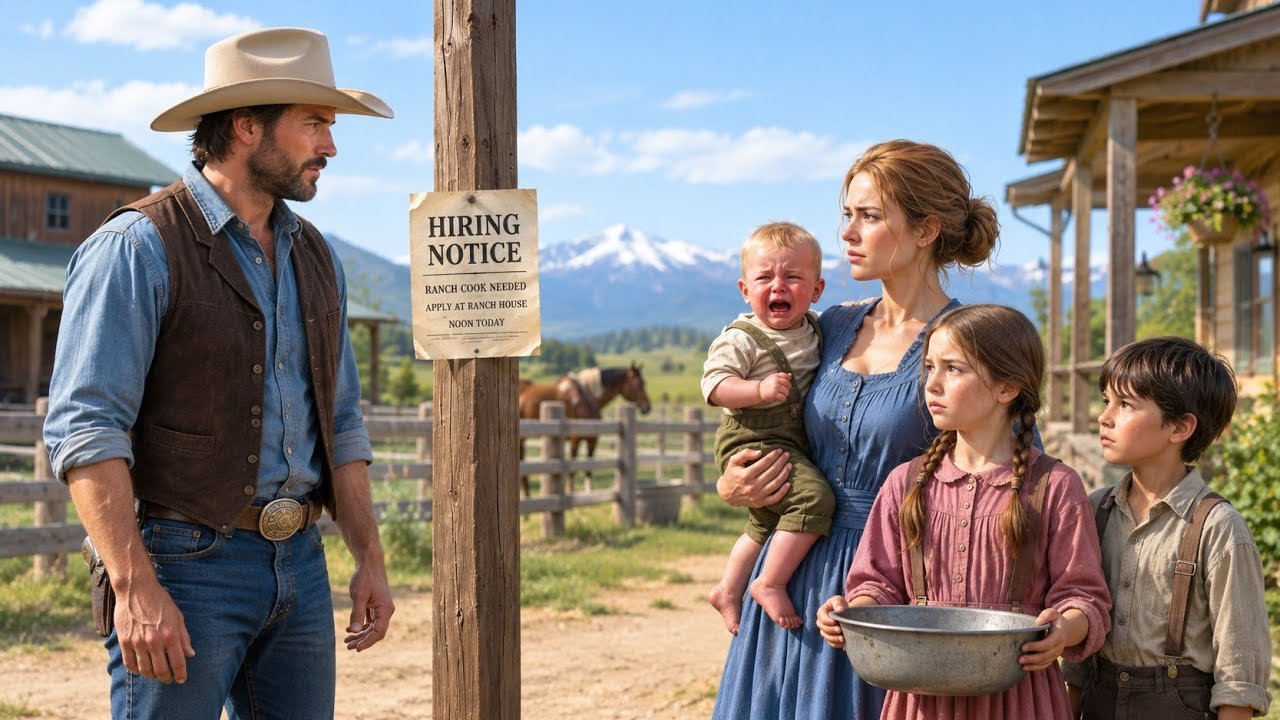
The man who’d posted a desperate notice at noon had been looking for a cook.
He’d found a family instead.
Sometimes the person who answers your call for help is the one who needs help most. And when we stop carrying everything alone, we discover that kindness can save more than a ranch. It can save a heart.
Have you ever been helped by someone at your lowest point, or helped someone at theirs? Share your story in the comments.
(Note: This story is entirely fictional and created for entertainment purposes only. It does not represent any organization or individual, nor does it encourage inappropriate behavior. Content is created with the support of artificial intelligence.)