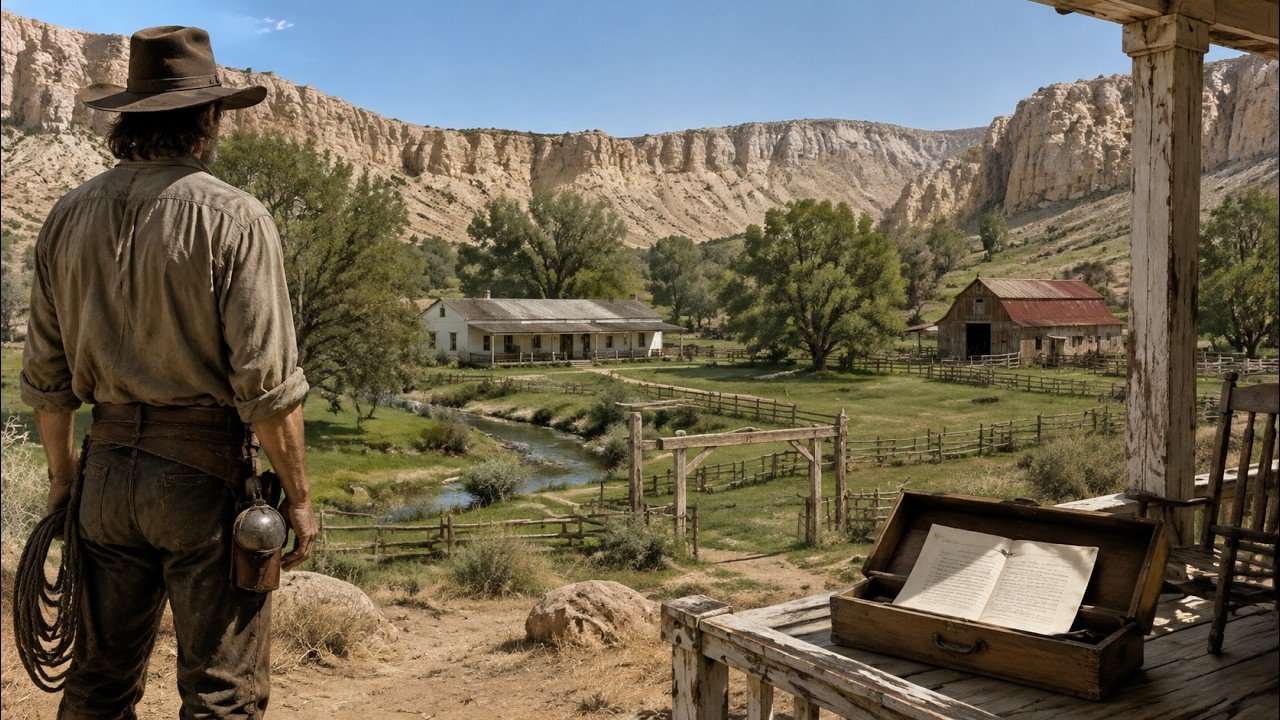
Part 3 🌄
“Walter. If you’re reading this, you kept your word and came up here. I knew you would.”
“I never was good at saying things out loud. You know that better than anybody. So I’ll say them here, where I don’t have to watch your face.”
“I lost my boy the summer before you came. When that wagon brought you up with a paper tag on your shirt, I thought God was playing a cruel joke on me. I didn’t want another boy to lose.”
“So I didn’t hug you. I didn’t tell you I was glad. I gave you a cup of coffee and a job. It was all I knew how to give.”
“But you were the son I got to keep, Walter. Forty years. You never once let me down.”
“I hid this up here because I don’t trust lawyers or kin I’ve never met. But I trust you to keep a promise. And I trust the second ridge.”
“The land is yours. It was always going to be yours. You earned every acre of it before you were twenty.”
“I’m sorry about Ruth. I know you stayed for me. I should have sent you after her. That’s the one thing I’d take back.”
“Drink from the cup, son. It’s yours now too.”
“Ellis Broaden.” 😭
Walter folded the letter along its three creases.
He laid it on top of the deed. And put them both inside the tin box with the rusted flowers.
He sat a long time with his hand resting on the lid.
Then he stood up.
Because a man who’s just been told in writing that a place is his doesn’t honor that by sitting still.
He set the tin box at the head of the bunk. And folded his mother’s blanket over it.
The two things that mattered most. Together in one corner.
Then he went to work.
He pried up the rotten floorboard. Crawled under with a candle and cut out the punky beam. Hewed a new one from a fallen tree.
He took the door off its hinges and planed it until it swung true and latched without lifting.
He split four new roof shingles and nailed them in.
He re-wired the stovepipe and sealed it with creek clay and horsehair from his own horse’s mane.
He worked until the sky went red, then blue.
That night, he slept on the bunk with the tin box at his head.
The first night in forty years he slept on land that was his. 🥹
The next morning, he rode straight down the valley to the county recorder.
An old, stooped man named Abel Pike. He’d recorded deeds in that county for thirty-one years.
He knew Broaden’s handwriting as well as Walter did.
Walter laid the deed on the counter and stood with his hat in his hands.
Pike read it through. Twice. Without a word.
Walter barely breathed.
Then Pike dipped his pen. Entered the deed in the great ledger. Pressed the county seal into the wax.
He handed Walter a signed certificate.
“Broaden was a careful man,” Pike said. “This is clean.”
Walter paid the one-dollar-and-forty-cent fee out of his old tobacco tin.
And rode home with the certificate tucked inside his shirt. Right against his heart.
He sent word to the lawyer: The will has been found. In Broaden’s own hand. It’s recorded. Stop the auction.
Eight days later, Howerin rode up again. Alone. No satchel.
He read the deed, the letter, and the certificate at the plank table while the coffee heated.
Then he folded them carefully and placed them back in Walter’s hands.
“It’s good,” he said. “I’ll write to the nephew. The matter’s settled.”
At the door, he paused.
“Broaden knew exactly what he was doing after all.”
“I believe he knew for a long while,” Walter said.
Howerin rode away into the timber.
And this time, Walter watched him go without that weight in his chest. ⚖️
The nephew wrote back in April. One sheet.
I will not contest it. I wish the ranch well.
Then, as the snow melted from the meadow, the neighbors started coming.
A rancher named Aught Renner led up a young ram he’d owed Broaden for three seasons. He stayed for supper. Then came back with his son and helped Walter rebuild the north fence. He wouldn’t take a cent.
The widow who’d left the beans at the funeral, Mrs. Deal, rode up with a broody hen sitting on eggs, a jar of sourdough starter from her mother’s time, and a loaf of bread.
“A man alone needs bread that isn’t cornmeal,” she told him firmly.
After that, a loaf came up the trail most Fridays. And Walter sent down a quarter of beef each fall.
The blacksmith came to ask if the new owner would keep the old account.
“I’ll keep it,” Walter said.
The blacksmith reshod a loose shoe right there on the porch step. And wouldn’t take pay for it.
“I’ll take pay for the next one,” he said.
“That’s fair,” said Walter. 😊
By August, men in town touched their hats when Walter rode by.
And called him Mr. Mercer.
He’d never been called that in his whole life.
He didn’t correct them.
Because it was the name the old man’s deed had given him.
Every Sunday, he rode the fence line. Whether it needed riding or not. Because Broaden always had.
Every first Saturday, he sat an hour on the bench outside the general store. Men sat with him and talked weather and hay prices.
He spoke when spoken to. Listened the rest of the time.
And that was accepted as his way.
And every evening, he ate supper at the table in the main house.
And drank his coffee from the old man’s tin cup.
Something he couldn’t do the night of the burial.
Drink from the cup, son. It’s yours now too. 🥹
In September, a freight agent came up with a load of wire.
He mentioned, in passing, that his wife had asked after Bear Fork when she heard the old rancher died.
She’d asked if the hired man was still there.
“Used to be a schoolteacher,” he said. “Name of Ruth.”
Walter unloaded the wire. Paid for it.
Said nothing.
But that evening, he unfolded his mother’s blanket and looked at the pressed sprig of yarrow a long time.
Then he moved it into the tin box.
With the deed. And the old man’s letter.
All the things people had left him. Together under one lid.
One late October evening, the first hard frost silvered the meadow.
Walter sat at the table with the tin cup, the fire low in the stone hearth he’d learned to build as a boy.
The tin box sat on the mantel. Its rusted flowers catching the firelight.
He thought about the little boy who came up in a supply wagon with a paper tag on his shirt.
He thought about the quiet old man who set a cup of black coffee in front of that boy.
And said almost nothing.
And meant to say so much.
The nephew never knew where the papers were.
The lawyer didn’t know.
Nobody knew.
Only the old man.
And the old man had trusted three things.
A lonely shack on the second ridge.
Forty winters.
And a boy who would always keep his word.
Walter took the letter out one more time. Read it by firelight.
“You were the son I got to keep.”
He folded it. Put it back.
And finished his coffee.
Forty years a ranch hand. Never owned an acre.
Now every acre of Bear Fork had his name on it.
But the thing that mattered most wasn’t the land.
It was finally knowing that, all along, he’d been somebody’s son. ❤️🌄
✨ The people who love us the quietest sometimes love us the deepest. And faithful work done for decades, with no one watching, is never truly unseen.
💬 Has someone in your life shown their love through actions instead of words? Tell me about them in the comments.
(Note: This story is entirely fictional and created for entertainment purposes only. It does not represent any organization or individual, nor does it encourage inappropriate behavior. Content is created with the support of artificial intelligence.)