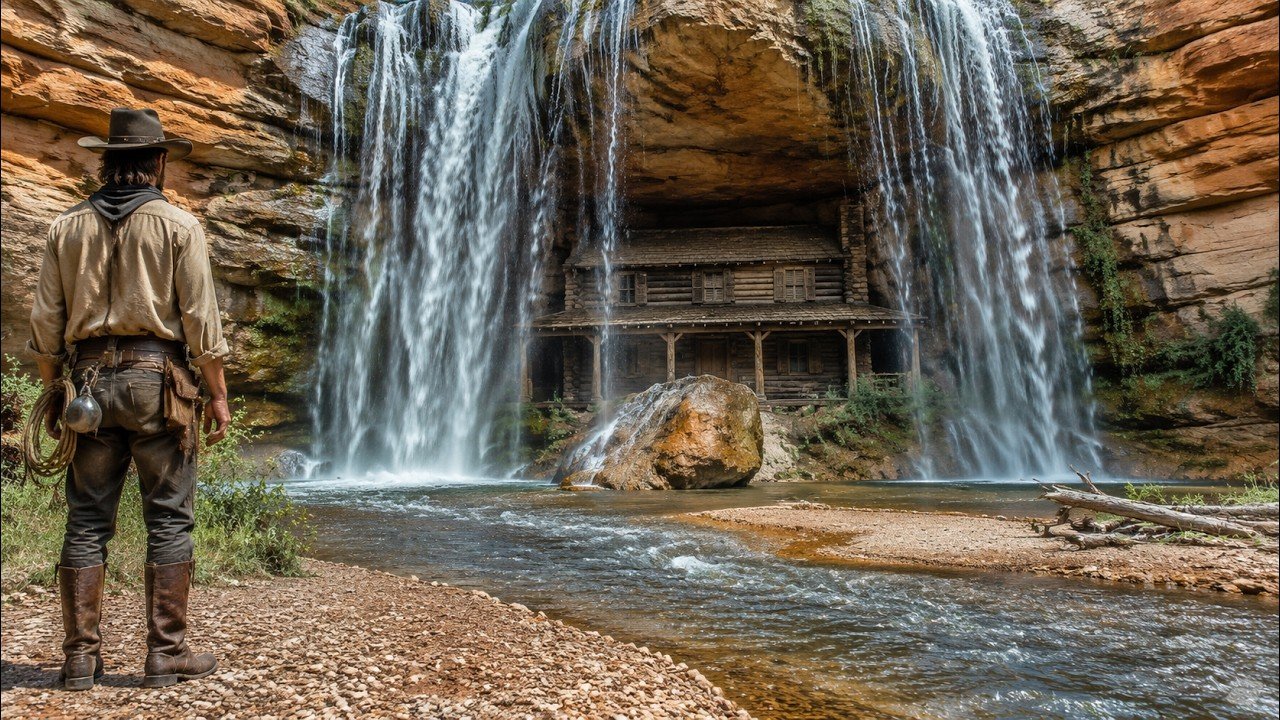
Part 3 🌄
To the stranger who has found my home…
The letter was signed Josiah Meek.
A prospector from Missouri.
He came to the North Fork in the winter of 1849. And lived behind Widow Falls for thirty-one years.
In his second year, he lost his wife, Ruth.
In his fourth, he lost his little boy, Thomas.
After that, he stayed. Alone.
He worked a small, quiet vein of silver in the rock wall of the gorge. Cut timber. Kept his tools. Kept his cabin.
And put away what the mountain gave him, in the crates under his bunk.
“A man who has buried his people learns quickly,” he wrote, “that money is only a way of carrying work forward. Past the end of one life. Into the beginning of another.”
He had no family left in the world.
“I have prayed a long time,” he wrote, “that whoever finds this place will be a working man. Not a thief.”
He hoped the finder would use what was in the crates to build an honest living on the ground below the falls.
And at the very bottom of the fourth page, in the same careful pencil:
“I have been happy here. I hope you will be, too.” 😭
Charles read it twice.
Then he folded it. Put it in his coat. Right next to the deed.
He sat a long time on that floor.
His hand resting on Emmett Poe’s knife in his pocket.
Then he stood up.
And went to work. 💪
The first week, he worked alone.
He swept the floor. Beat the dust out of the wool blanket against a rock by the pool.
He lit a fire in the black iron stove. And boiled coffee in his mother’s tin pot.
The smoke drew clean up the hidden chimney in the rock.
He walked every foot of his land. And below the pool, he found something he’d missed the first day.
A flat of good grass.
He’d missed it because he’d been looking up.
He rode down to the settlement with two silver dollars from Josiah’s crate. Filed his deed at the little log courthouse. Paid the fee. Rode back the same day.
The town blacksmith, Hollis Renner, fifty-eight, heard a Gray had taken the strip up the North Fork.
The next week, Hollis rode up on a mule with his tools and a sack of nails.
He stayed two days and helped Charles build a pole corral.
He wouldn’t take a cent. Only a plate of beans and a cup of coffee.
A widow named Mary Ann Doggett, who kept a little dairy, sent up butter and a wheel of cheese.
And a note in pencil.
Welcome to the North Fork. 🥹
Then a young cowhand named Ned Purdy came up the trail. Twenty-two. Out of work for the winter.
“Any labor, sir?”
Charles hired him on the spot. A dollar a day. Paid fair. Paid on time.
By the first snow, they had a sturdy corral. A plank shed. And a road cut by hand down to the settlement, wide enough for a wagon.
Charles bought twelve young heifers and one red bull from a man breaking up his outfit.
He paid in cash. Counted out plainly on the store counter.
He and Ned drove them up the North Fork themselves.
And turned them into that corral at dusk, with the waterfall roaring softly and the smoke rising through the rock above.
Word spread slowly around town, the way word spreads in winter.
That Gray up the North Fork pays cash. Pays his hand on time. Never owes a soul.
And after that, men stopped calling him the youngest Gray.
Or the one who got the waterfall.
They called him Charles.
Or Mr. Gray. 💛
Through the winter, Ned stayed on.
In the evenings, they sat in the cabin behind the falls with the door open. The sound of the water steady and soft.
Charles read aloud from old almanacs and county papers by lantern light.
Ned mended tack.
Neither said much.
Neither needed to.
Charles kept small habits without ever deciding to.
Coffee on the stove from before dawn to after dark.
Josiah’s letter in the same pocket with the deed.
And every week, he oiled Josiah’s tools. Every single edge.
Exactly the way he’d found them.
So that if another lost man ever came behind him, the way he’d come behind Josiah, the tools would be waiting. Just as Josiah left them.
He hung his mother’s tin coffee pot on a peg beside the lantern.
And it looked like it had lived there thirty years.
In April, the snow melted in a week of soft rain.
The grass below the pool came up green and sudden, the way mountain grass does just once a year.
One evening, Charles stood on the dry gravel behind the falls.
The cabin door open at his back. The water falling in a white column three steps in front of him.
And without meaning to, he counted what had come into his life since October.
Twelve heifers, heavy with calves.
A red bull grown gentle with work.
A shed with a new room built on for Ned. Who’d asked in March if he could stay through calving.
“Stay as long as you care to,” Charles had told him.
A real road down to town.
A grass lease on two sections of mountain pasture.
Friends who’d shown up without being asked.
And his name, written plainly in the county book.
He took Emmett’s knife out of his pocket. Turned it over once in his hand.
He thought of the old wrangler. Seven years of teaching. Never once raising his voice.
He thought of Josiah Meek. Thirty-one years behind this water. A wife named Ruth. A boy named Thomas.
“I have been happy here. I hope you will be, too.”
Two men he’d never seen in the same room. Never would.
One died by a bunkhouse stove. One died somewhere in this gorge, unrecorded.
Both had loved a boy they never got to see grown up.
And both had left behind something small, hard, and useful.
So that boy wouldn’t have to stand empty-handed in the cold. 😭
Charles set the knife on the table. Right beside his mother’s coffee pot.
They sat together in the lantern light. Like two quiet witnesses.
He looked at them a long time.
He didn’t say a word.
Word of Charles Gray traveled back down the wagon road eventually. All the way to the old home place.
A letter from Mary Ann’s cousin told him that Merritt and Jack had heard.
They didn’t know what to make of it.
They hadn’t written.
They wouldn’t.
And Charles found he didn’t mind.
He hadn’t gone up the North Fork to win an argument.
He’d gone because there was nowhere else to ride.
And he’d stayed because a waterfall, a cabin, and two dead strangers had given him what his own family never did.
A place to stand.
And a reason to stay.
His father left him rock and water and eighteen dollars.
Behind the water, he found a cabin.
Inside the cabin, a letter.
And inside the letter, a life he never knew he was meant to inherit.
It was the best eighteen dollars any man ever came into. 🌄
✨ Never judge what you’ve been given by how it looks from the outside. Sometimes the inheritance everyone laughed at is hiding the very life you were meant to live. You just have to be brave enough to walk behind the waterfall.
💬 Has there ever been a person or place others wrote off that turned out to hold more than anyone could see? Share it in the comments.
(Note: This story is entirely fictional and created for entertainment purposes only. It does not represent any organization or individual, nor does it encourage inappropriate behavior. Content is created with the support of artificial intelligence.)