Part 3 🌾
Nola found Clint in the barn and told him straight.
He went very still. That was how he thought.
Then he came back out of himself.
“There are homesteads south of the river,” he said. “Small grain farmers. Vore pays them so little they barely break even. But they’ve got no other buyer.”
He looked at her.
“There’s an old man named Feder. I’ve met him at the stockyards.”
“Go today,” she said.
“That’s a day and a half round trip.”
“Dennis and I will manage. Go.”
He looked at her a moment.
The man who’d shouted from the porch steps in August was gone.
He picked up his coat.
“I’ll be back tomorrow night.”
“I know.” 🐎
He came back dusty and tired.
Feder had listened. Asked for time.
And given Clint two more names. A farmer named Howell. And a widow named Crest, who ran her late husband’s land.
Nola wrote to all three that night. A fair price. Plain terms. No tricks.
Four days later, the answer came.
Yes. All three.
Enough wheat to finish the review. And carry them through the summer.
Clint read the letter twice.
“We’re going to make it.”
“Maybe,” Nola said.
“You always say maybe.”
“Because maybe is honest.”
“Maybe’s also better than the alternative,” he said.
And he smiled. A real one. 😊
The next three weeks were the hardest work Nola had done since she was twelve.
Bread before dawn. Beds at noon. Ledger at midnight.
Clint drove every delivery.
On one of the last, Ingvar held up a loaf and said:
“The men are working better this spring than any spring I can remember. The company doesn’t measure that yet. But it’s real.”
Nola wrote it in her ledger.
Not as a number.
As a reminder that the most important things don’t always fit in columns.
Then, five days before the deadline, the ice storm hit.
Rain turned to ice by midnight.
At 4 a.m., Clint came in soaked from checking the team.
“The road past the creek is solid ice. We can’t make it. Not in time.”
Nola stood very still.
Then one word.
“Stoker.”
“What?”
“Stoker has heavy workhorses. The kind built for ice. And he’s bought from us since that very first Wednesday.”
She was already pulling on her coat.
“Send Dennis to his place. Now.”
Clint caught her arm. Not to stop her. To make her pause.
“What if he can’t do it either?”
She looked at him.
“Then we did everything possible. But I’m not stopping until there’s no way through left.”
He let go. And ran to wake Dennis. 🏃
When Dennis pounded on Stoker’s door at 5 a.m., the cook didn’t ask what it paid.
He asked what needed doing.
Forty minutes later, he pulled up at the gate with two men and a freight wagon behind a pair of huge, shaggy horses.
“We’ll chain the wheels at the crossing,” he said. “I’m not promising we make it. I’m promising we try.”
“That’s all I’m asking.”
The road was glass.
At the creek crossing, one horse slipped. The wagon slid sideways.
Nola gripped the bench and didn’t make a sound.
Then the chains bit. And held.
They rolled into the camp at 8:52.
Eight minutes to spare.
Ingvar stood in the doorway. He looked at the chained wheels. The ice on Nola’s boots.
“You made it,” he said.
“We made it.” 😭
The next morning, the commission inspector arrived. A careful man named Coats.
And a small crowd gathered in the camp yard.
Feder. Howell. Crest, who’d driven three hours.
Stoker. Dennis, twisting his hat.
Mrs. Oland, who’d naturally told half of Harlan’s Crossing before breakfast.
And, arriving separately on his well-fed bay horse…
Sterling Vore.
He stood off to one side. Watching.
Nola had expected him.
And she’d decided it was perfect.
Because if her numbers were right, everything he’d done would be visible to everyone at the very same moment.
Coats went through every receipt. Every delivery log. Every grain record. Twice.
Two hours.
Then he looked up.
“This is over the required standard.”
“By about forty percent,” Nola said.
She’d added it up eleven times. Eleven felt like enough.
Coats set down his pen.
“In four years of reviewing suppliers, I have never seen anyone clear a review by this margin. Under these conditions.”
He picked up the ice-storm delivery receipt.
“This is thorough work, Mrs. Hadwell.”
He signed the renewal on the spot. ✍️
Nola stepped out into the morning sun.
Every face turned toward her.
And past them, a little apart, stood Vore.
She looked at him. Long enough for both of them to understand.
She didn’t say a word.
She didn’t need to.
Then she turned to the people who’d made it possible.
“It’s done.”
Feder gave one slow nod. Two years of patience, finally paid.
Stoker let out a low rumble that was his version of cheering.
Mrs. Oland squeezed her arm, hard.
And Clint just stood close. Close enough that she could feel him there. Solid. Certain.
Vore rode east without looking back.
He wasn’t ruined. He was too big for that.
But the grain farmers had seen something new today.
What fair looked like.
And once people have seen fair, it’s very hard to make them forget it. 💪
That afternoon at Mrs. Oland’s table, they signed it all on paper. Fair prices. Steady volume. Everyone protected.
“Vore will try another angle,” Feder warned.
“He will,” Nola agreed. “But six months ago, I was one woman with a vegetable stand. Now there are five of us. When he pushes on one, he pushes on all of us. And we’ll all see it.”
Feder studied her.
“You’re not what I expected.”
“What did you expect?”
“Someone more frightened.”
She smiled. “I was frightened. I just couldn’t afford to look it.”
The old man laughed out loud. So did everyone else. 😂
The ride home was quiet. Stars coming out over the hills.
“The bank note,” Nola said. “With the new contract, we can clear it. September, maybe.”
“That’s the last one,” Clint said.
“That’s the last one.”
A long stretch of road.
“Nola,” he said.
Just her name. Like it was a whole sentence.
“I know,” she said.
And she did.
She put her hand over his on the reins.
He turned his palm up and held hers.
They drove home like that. ❤️
The bank note was paid in full on a Friday in September.
Clint stood outside the bank afterward in the warm morning sun.
That night he told her how it felt.
“Like setting down something I forgot I was carrying. I’d started to believe that’s just who I was. A man who owed.”
“You built this place,” she said.
“We built this place,” he corrected.
She didn’t argue. Because it was true.
And they’d learned to always be true with each other. 🏡
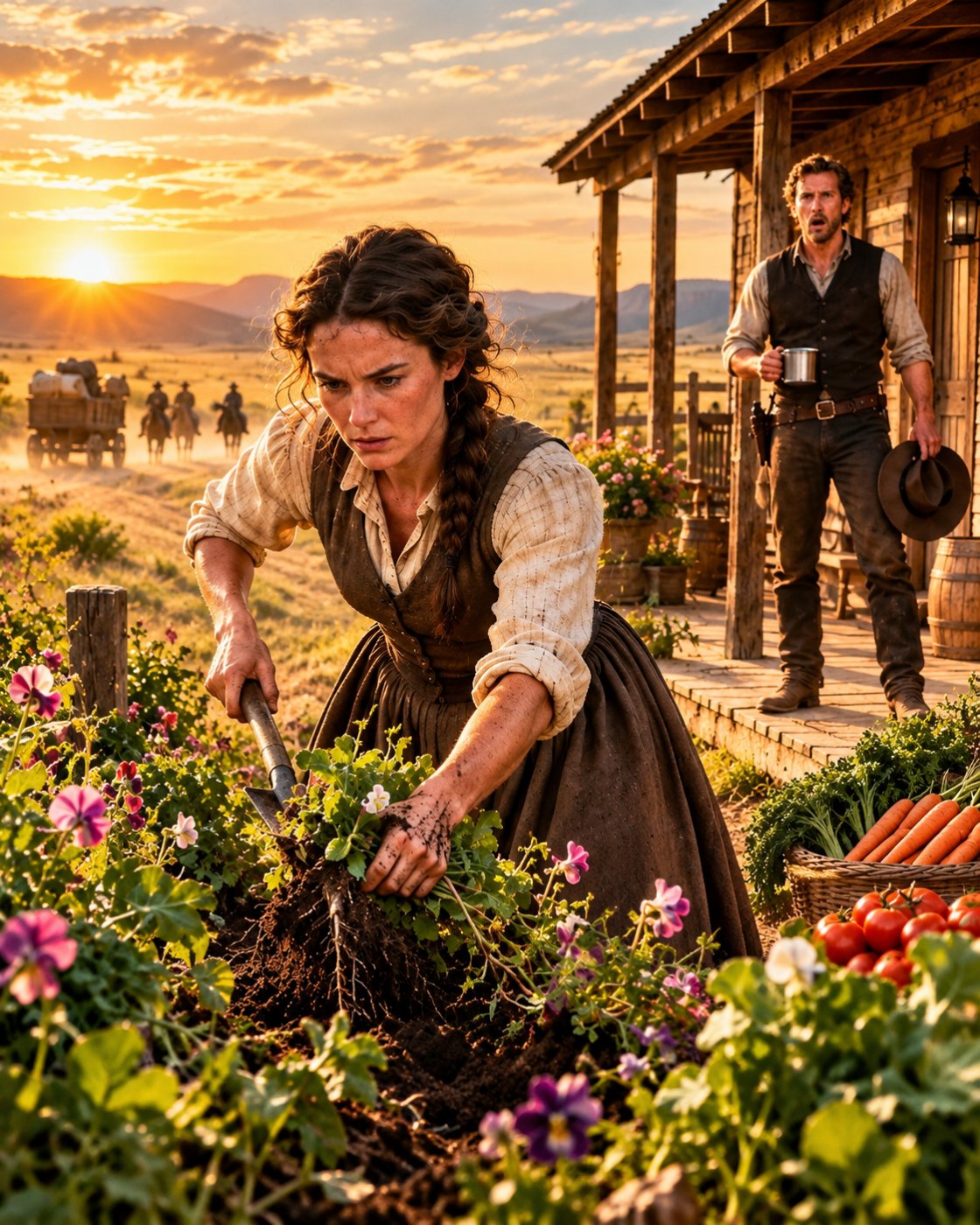
Exactly one year after the sweet peas, Nola was checking the beds at sunset.
Every inch of that front yard was green and growing now.
Beans climbing the cedar posts Clint had set that first hard autumn.
Tomatoes along the fence. The market stand freshly painted by Dennis.
And above the kitchen window, where nobody could miss it…
A single climbing sweet pea vine.
Clint had planted it there himself in the spring. Without telling her.
“Something pretty,” he’d said gruffly. “Where it doesn’t cost us anything.”
She’d cried a little. She never told him. He knew anyway. 🌸
A wagon slowed at the gate.
A young family. Kids in the back. Everything they owned piled high.
Heading west with that mix of hope and not-quite-ready Nola remembered so well.
The wife leaned forward, studying the garden.
“You grow all this yourself?”
Nola thought about Clint’s irrigation. Dennis’s steady hands. Feder’s wheat. Stoker’s horses on the ice. Mrs. Oland’s warnings.
“No,” she said. “Not by myself.”
The woman nodded like that was exactly the right answer.
The wagon rolled on into the evening.
And Nola went back to work in the beds.
Which was exactly where she wanted to be. 🌄
✨ Looking prosperous and being prosperous are two different things. Real strength is choosing what’s true over what looks good, and being brave enough to let people talk while you build.
💬 Would you have torn out those sweet peas, or waited for Clint to agree? Tell me honestly in the comments!
(Note: This story is entirely fictional and created for entertainment purposes only. It does not represent any organization or individual, nor does it encourage inappropriate behavior. Content is created with the support of artificial intelligence.)