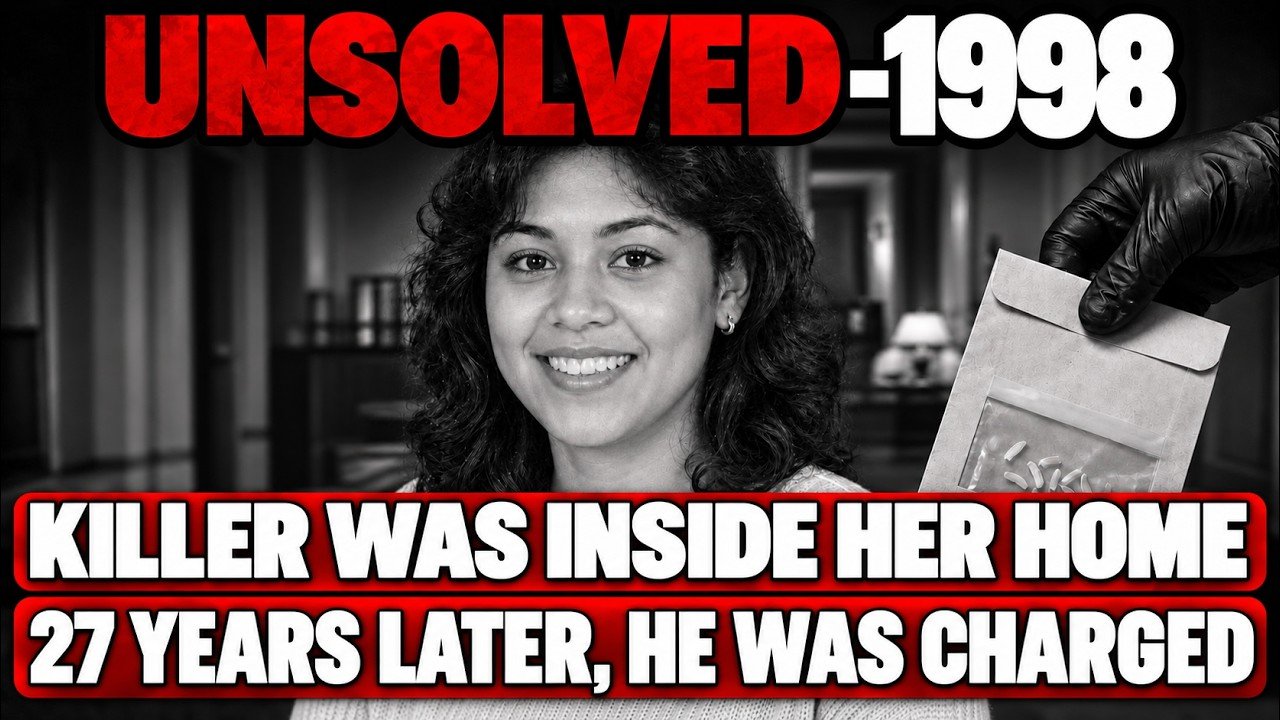
INDIANA 1998 Cold Case Solved After 27 Years — Killer Was Inside Her Home
Detectives in Gary, Indiana, knew his name in 1998.
He was in their notes.
He was connected to the victim.
He had motive, access, and a history of intimidating her.
And still, Alfred Kevin Sanders walked free for 27 years.
On December 29th, 1998, Jacquine or Jackie Sodto was found strangled inside her home on Buchanan Street in Gary.
Christmas lights were twisted around her neck.
The scene had been staged to look like a robbery, but nothing about it added up.
A television was missing from the house, yet its speakers were still sitting in the room.
Dresser drawers had been pulled out and left scattered on the floor.
There was blood everywhere.
Broken glass across multiple rooms and bloody shoe prints tracked through the hallway and up the staircase.
This was not a break-in.
Whoever killed Jackie Sodto knew that house, knew the layout, knew her.
The case went cold.
Gary was drowning in violence at the time, logging close to a 100 homicides a year in a city of barely 120,000 people.
Jackie's murder slipped through the cracks of an overwhelmed system, and her file joined a growing stack of unsolved cases in Lake County.
That was 1998.
By 2025, the tools to solve her murder finally existed.
During Jackie's original autopsy, a forensic examiner had clipped her fingernails and sealed them into evidence storage.
It was a standard procedure, routine.
Nobody thought twice about it at the time, but that decision made in a morg in Gary, Indiana more than a quarter century ago would become the single most important piece of evidence in this entire case.
When modern DNA extraction techniques were applied to those preserved clippings, two genetic profiles emerged.
One belonged to Jackie Sodto.
The other belonged to an unknown male.
That unknown profile was uploaded into Cotus, the national DNA database maintained by the FBI.
And in September 2025, the database returned a match.
The name that came back was the same one detectives had written down 27 years earlier.
Alfred Kevin Sanders, known around the neighborhood as Sunday School.
This is the story of how a 27-year-old cold case in one of America's most violent cities was finally solved.
Not by a dramatic confession, not by a witness coming forward at the last minute, but by fingernail clippings, a federal database, and investigators who refuse to let Jackie Sodto be forgotten.
This is Cold Case Redemption.
We tell the stories of the victims who were left waiting for justice, sometimes for decades, until a breakthrough changed everything.
And if you believe cases like Jackie's deserve to be told, drop a like on this video and subscribe to the channel.
Every case we cover here went cold.
None of them stayed that way.
To understand why Jackie Sodto's murder went unsolved for nearly three decades.
You have to understand the city where it happened.
Not just the street, not just the neighborhood, the entire machinery of a place that was falling apart from the inside out.
Gary, Indiana sits on the southern shore of Lake Michigan, roughly 30 mi southeast of downtown Chicago.
If you've driven through northwestern Indiana on the interstate, you've seen the skyline, the smoke stacks of the old steel mills, the rusted out infrastructure of what was once one of the most productive industrial corridors in the United States.
The kind of place where you can feel the history just by looking at the buildings and where most of that history is about loss.
For most of the 20th century, Gary was a steel town.
United States Steel Corporation had essentially built the city from scratch in 1906, naming it after the company's chairman, Elbert Garry.
For decades, the mills along the lakefront provided tens of thousands of jobs.
Families moved in from across the country, many of them black families migrating from the south, drawn by the promise of steady, well-paying industrial work.
At its peak in the 1960s, Gary's population topped 170,000 people.
The city had theaters, department stores, a functioning downtown, and a tax base that supported schools, parks, and public services.
Then the steel industry collapsed, and Gary collapsed with it.
The decline didn't happen overnight.
It was a slow bleed that stretched across the 1970s and 1980s.
Mills closed.
Jobs vanished.
The people who could afford to leave did.
White flight hollowed out entire neighborhoods.
Property values cratered.
The tax base that had supported city services disappeared and the services went with it.
Entire blocks of homes were abandoned.
Storefronts were boarded up.
Schools closed.
The city's infrastructure aged and rotted, and there was no money to replace it.
By the 1990s, Gary had lost more than a third of its population.
And the void left by the economy was filled by something else entirely.
Drugs and violence.
The crack epidemic hit Gary harder than almost anywhere else in the Midwest.
Open air drug markets operated on corners that had once been residential blocks.
Abandoned homes became stash houses.
The underground economy grew as the legitimate economy shrank.
And with it came the territorial violence, the retaliatory shootings, and the kind of routine, grinding lethality that turns an entire city into a crime scene.
In the mid 1990s, Gary Gary recorded a staggering number of homicides for its size.
In some years, the count climbed above 100 killings.
For context, Gary's population at the time was roughly 119,000 people.
The national average murder rate was around 9 per 100,000.
Gary's rate was nearly 10 times that, approaching 90 per 100,000 in the worst years.
It was, by several measures, one of the most dangerous cities in the entire United States.
The police department was overwhelmed.
Budget cuts had reduced staffing to levels that were barely adequate for routine policing, let alone the kind of sustained investigative work that complex homicide cases require.
Detectives weren't handling one or two cases at a time.
They were juggling double digits.
Crime labs were backlogged.
Forensic resources were limited.
And in neighborhoods where the drug trade had taken root, witness cooperation was rare.
Talking to the police could get you hurt.
Talking to the police about a murder could get you killed.
This is where you have to zoom in to understand what happened to Jackie Sodto.
Because her murder didn't happen in isolation.
It happened inside a system that was already buckling under the weight of cases it couldn't close.
Detectives weren't lazy.
They weren't indifferent.
They were buried.
When you're processing a 100 homicides a year in a department designed to handle a fraction of that number, cases without immediate physical evidence or cooperative witnesses get pushed to the side.
Not because they don't matter, but because another body just came in and that one is still fresh and that one has a witness who is willing to talk right now.
And if you don't get to the scene in the next hour, that witness might change their mind.
Jackie's case landed in the middle of that storm.
A woman found strangled in her home.
Evidence of staging.
A suspect who was connected to her, but who hadn't confessed and whom nobody had witnessed committing the crime.
In a city that wasn't drowning in violence, this case might have gotten the sustained focused attention it needed.
In 1998, Gary, it got what the system could give and the system couldn't give enough.
That is the context, not an excuse, an explanation, and one that matters.
Because without it, you'd look at 27 years of silence and assume nobody cared.
People cared.
The infrastructure around them just couldn't keep up.
If you're the kind of person who watches cases all the way through, hit subscribe.
We go deep on every one of these.
Jacqueline Sodto lived in Gary during what may have been the most difficult period in the city's modern history.
What we know about her comes primarily from investigative records.
And the testimony of people who were part of her life because the national press never covered her murder.
And the local coverage from December 1998 has largely disappeared behind paywalled archives and deteriorating microfilm.
Here's what we can confirm.
Jackie lived in Gary and was connected to at least two addresses that investigators would later reference in the case file.
One was a residence on Faget Street where she spent time and received visitors.
The other was the home on Buchanan Street in the 500 block where she was killed.
Based on available records, Jackie was likely in her early 30s at the time of her death, though her exact age has not been independently confirmed by news reporting.
Jackie's world intersected with the drug trade in Gary.
This is not a judgment.
It's a fact that the case file makes explicit.
She knew people who bought and sold drugs.
She was involved in transactions herself.
And through that world, she became entangled with a man named Alfred Kevin Sanders.
Sanders was known around Gary by a nickname.
People called him Sunday School, not because he was religious or because the name carried any kind of ironic meaning that anyone has explained publicly.
It was just a nickname that stuck the way nicknames do in tight-knit neighborhoods where everybody knows everybody and where reputation is a currency of its own.
Sanders was a large man, physically imposing, and he was known to sell drugs in the area.
At some point before her death, Jackie began selling drugs on Sanders's behalf.
This wasn't a partnership between equals.
It was an arrangement that created financial dependency, a tether between Jackie and a man who, by multiple accounts, was not someone you wanted to owe anything to.
A longtime friend of Jackie's would later provide investigators with a detailed and consistent account of what that relationship looked like from the outside.
This friend had known Jackie for years.
She told detectives that Jackie was afraid of Sanders, not in a vague, general, abstract sense, specifically and consistently afraid.
in the way that someone is afraid of a person who has demonstrated through their behavior and their physical presence exactly what the consequences of defiance might look like.
According to this friend, Sanders believed that Jackie had money belonging to him.
Whether Jackie actually owed him money, whether this was a legitimate debt from a drug transaction, or whether this was a pretext for control and intimidation, the case file does not fully clarify.
What the friend described was a pattern of behavior.
When Sanders came to visit Jackie at her Fyet Street residence, he would take her into a room alone and close the door.
Other people in the house were excluded from these conversations.
And the friend said that Jackie appeared visibly frightened during and after these encounters.
Not annoyed, not uncomfortable.
Frightened.
I mean, think about that for a second.
This was a woman who was inshed in a dangerous relationship with someone who had both the physical size and the street reputation to enforce whatever he wanted.
And in a neighborhood where involving the police was not just socially unacceptable, but potentially lethal, Jackie's options for getting out of this arrangement were severely limited.
There was no easy exit, no hotline to call, no protective order that would have meant anything in a part of Gary where the drug trade wrote its own rules.
This dynamic, the fear, the isolation, the closed door confrontations, the disputes over drugs and money would become central to the case decades later.
Because when investigators finally had the forensic evidence to reopen the file, this testimony gave that evidence a framework.
DNA under Jackie's fingernails placed Sanders in physical contact with her around the time of her death.
The friend's account explained why that contact might have turned violent.
It provided motive, opportunity, and a pattern of escalating intimidation that made the forensic evidence more than just a data point.
It made it a story.
This decision seemed small at the time.
It was just a friend talking to detectives, telling them what she'd seen, what she'd heard, what Jackie had shared with her.
But that willingness to speak, to put on the record what she knew would prove to be one of the most critical pieces of the entire investigation.
On the evening of December 29th, 1998, Jackie Sodto's landlord arrived at the home in the 500 block of Buchanan Street in Gary and made a discovery that would launch a homicide investigation lasting more than a quarter of a century.
He found Jackie inside the home lying face down on the floor.
Her body was positioned in a pot.
Christmas lights had been wrapped around her neck.
She was not breathing.
She was already dead.
When Gary police officers responded to the scene and homicide detectives began processing the home.
What they found was not a clean crime.
It was sustained deliberate violence followed by a clumsy attempt at misdirection.
Blood was present throughout the home, not confined to one room, but spread across multiple areas, suggesting either a prolonged struggle or post-mortem movement of the body, or both.
Broken glass was scattered across the floors.
Bloody shoe prints had been tracked through the hallway and up the staircase, then back down again, as though someone had moved through the house methodically.
After the violence had already occurred, checking rooms, touching surfaces, trying to accomplish something beyond just the killing itself.
A pair of broken eyeglasses lay near Jackie's body.
Suspected drug paraphernalia was found inside the home.
consistent with what investigators already knew about the drug activity connected to the address.
And then there were the details that made detectives pause and look more carefully.
A television set was missing from the house, but its external speakers had been left behind, still sitting in the room where the television had been.
Dresser drawers in the bedroom had been pulled out from the furniture and left on the floor, their contents disturbed.
At first glance, the scene might have read as a burglary gone wrong.
Someone breaks in, robs the place, encounters the occupant.
Things turn violent.
It's a narrative that would be plausible in a city with Gary's crime rate, but that reading did not survive closer scrutiny, and the detectives processing the scene did not buy it.
If you're burglarizing a home and you take the television, you take the speakers, too.
You don't carefully disconnect one component and leave the other sitting in plain sight.
That's not how theft works.
And pulled out dresser drawers are one of the oldest staging techniques in the criminal playbook.
It's what someone does when they want a crime scene to tell a story that isn't true.
They want the police to see a ransacked bedroom and think robbery before they think anything else.
Detectives believed based on the physical evidence and the inconsistencies in the scene that this murder had been staged.
Whoever killed Jackie Sodto had tried to disguise a targeted personal killing as a random property crime, and they hadn't done a particularly convincing job of it.
The autopsy confirmed what the crime scene already strongly suggested.
Jackie Sodto's official cause of death was asphixxia due to strangulation.
The medical examination revealed extensive soft tissue hemorrhaging in and around her neck, indicating sustained compressive force along with multiple neck abrasions consistent with the ligature marks from the Christmas lights.
She had also suffered blunt force trauma to the back of her head and lacerations on her face.
These additional injuries suggest that the attack was not limited to the strangulation itself.
Jackie had been beaten before, during, or after the strangulation.
The Lake County Medical Examiner classified her death as a homicide.
Strangulation is a significant detail, and it's worth pausing on why.
In homicide investigation, the method of killing often tells investigators something about the relationship between the perpetrator and the victim.
Strangulation is what criminologists call a close contact method of killing.
It requires physical proximity, sustained effort, and a duration that most experts estimate at between 4 and 10 minutes to produce death by asphixxia.
It is one of the most physically intimate forms of homicide, and it is overwhelmingly associated with perpetrators who have a personal relationship with their victim.
Strangers rob, shoot, and stab.
People who strangle tend to be people who know the person they are killing.
This was not a stranger crime.
The staging, the method, the lack of forced entry, the killer's familiarity with the layout of the house.
Every piece of evidence pointed in the same direction.
Jackie Sodto was killed by someone in her own circle.
And then came the detail that would change everything 27 years later.
During the autopsy, the forensic examiner followed standard protocol and clipped Jackie's fingernails, both hands.
The clippings were collected, labeled, sealed, and placed into evidence storage in 1998.
This was a standard part of homicide autopsy procedure.
Fingernail clippings are standard because if a victim struggled against their attacker, skin cells, blood, tissue, or other biological material from the asalent can become trapped beneath the nails during defensive scratching or clawing.
But in 1998, the DNA extraction technology needed to recover and accurately analyze trace amounts of biological material from something as small as a fingernail clipping was either non-existent or in its earliest and most unreliable stages.
The clippings were preserved because that's what the protocol required.
It was a box that got checked, a step in a process.
Nobody standing in that autopsy suite could have predicted that those clippings would sit in evidence storage for 27 years, waiting for science to catch up with the crime.
The investigation that followed Jackie Sto's murder began the way most homicide cases begin in a city like Gary.
Detectives canvased the Buchanan Street neighborhood.
They knocked on doors.
They talked to people who lived near Jackie, people who knew her, people who frequented the home.
They pieced together a picture of her social circle, her relationships, her movements in the days and weeks before December 29th.
Alfred Kevin Sanders came up quickly.
He was already known to law enforcement and Gary.
He was connected to Jackie through the drug trade.
He had been inside her Buchanan Street home on multiple occasions.
He was a large man with a presence in the neighborhood and a nickname that everyone recognized.
Sunday School, the friend's testimony, whenever it was initially provided to investigators, painted a troubling portrait.
Sanders and Jackie had a volatile, fear-driven dynamic.
He believed she owed him money.
He had isolated her during visits.
She was afraid of him.
Sanders was considered a suspect.
His name went into the case file.
He was by any reasonable investigative assessment on the radar from the very beginning.
But being on the radar is a very different thing from being charged with murder.
And in 1998, the distance between those two positions was enormous, particularly in a jurisdiction like Gary.
Think about what detectives actually had to work with.
They had a victim who was entangled in the local drug trade, which meant the pool of people with potential motive to harm her was not limited to a single individual.
They had a crime scene that pointed to someone who knew the house, but no eyewitness who had seen the killing happen.
They had a suspect who was connected to the victim and who had motive, but no confession and no direct physical evidence tying him to the act of murder itself.
The friend's testimony established fear and a pattern of intimidation, but it didn't place Sanders at the scene on December 29th, and the fingernail clippings were sitting in evidence storage, unprocessed.
The DNA locked inside them was invisible to the forensic technology available in 1998.
In that era, DNA analysis required substantial wellpreserved samples to produce anything useful.
a full blood sample, a saliva swab, a significant tissue deposit.
The trace amounts of biological material that might be recovered from beneath a victim's fingernails were considered too small and too degraded to be reliably tested.
Labs could attempt extraction, but the likelihood of obtaining a clean, identifiable profile from such minute quantities was low enough that many jurisdictions did not even bother trying.
It was like holding the answer key to a test but not being able to read the language it was written in.
Surrounding all of this was the relentless reality of Gary's criminal justice system at the time.
The homicide detectives assigned to Jackie's case were not working a single investigation.
They were juggling a case load that would be considered unmanageable by the standards of any major city.
New homicides were coming in constantly.
every week brought fresh victims, fresh crime scenes, fresh witnesses who needed to be interviewed immediately before they disappeared or changed their stories.
Lab turnaround times were measured in months, not days.
And in a community where cooperating with a murder investigation could make you the next victim, witnesses were scarce, reluctant, and unreliable, the case stalled.
Not with a dramatic dead end or a public announcement.
It stalled the way cold cases always stall, quietly, incrementally.
The leads that existed couldn't be converted into charges.
New cases demanded immediate attention.
The detective originally assigned may have been transferred, promoted, or retired.
And over the months and then the years, Jackie Sodto's murder settled into the backlog of unsolved homicides in Lake County, Indiana.
You'd think someone would have said something.
You'd think that in a neighborhood where Sanders was known, where people called him Sunday school, where his connection to Jackie was not a secret, that somebody would have come forward with the one piece of information that could have broken the case open.
Nobody did, and the file gathered dust.
Sanders remained a free man.
He continued to live in Gary.
The fingernail clippings sat in evidence storage, sealed in their original packaging, preserving a genetic signature that would remain unreadable for more than two decades.
The case was open in name, but in practice it was cold.
Stone cold.
This is where the story goes quiet for a very long time.
And 27 years is not an abstraction.
It is not a number you glance at and move past.
It is the span of an entire generation.
A child born the year Jackie Sodto was killed would have graduated from high school, gone to college, entered the workforce, possibly started a family of their own.
All while her case sat dormant in a filing cabinet in Lake County.
But the world around that filing cabinet was not standing still.
Both the city and the science were changing.
Gary continued to struggle through the 2000s and 2010s.
The population kept declining.
By the 2020 census, Gary was home to fewer than 70,000 people.
Less than half of its 1960s peak.
Entire neighborhoods had been reclaimed by nature.
Vacant lots outnumbered occupied homes on some blocks.
The steel mills that had built the city were largely silent, their rusted frames visible from the interstate like the skeleton of something that used to be alive.
And yet something shifted.
Slowly, unevenly, imperfectly, the violence that had defined Gary for decades began to recede.
Community intervention programs took hold.
Policing strategies evolved.
And by 2025, something remarkable happened.
Gary recorded 28 homicides for the entire year.
That was the city's lowest total in 55 years, the lowest since 1970.
For a city that had been averaging a 100red or more killings per year during the 1990s, this was a transformation that few outside observers would have predicted and that many residents had stopped believing was possible.
Meanwhile, far from the streets of northwestern Indiana, forensic science was undergoing its own revolution.
DNA analysis in the late 1990s was limited in ways that are hard to appreciate from a 2026 perspective.
The technology existed in 1998, but it required relatively large, wellpreserved biological samples to produce usable genetic profiles.
A blood stain the size of a quarter might work.
A clear saliva sample might work.
But trace evidence, the kind found under fingernails, on door handles, on clothing fibers, was often too small or too degraded to yield reliable results.
Many samples that were collected and preserved during this era were essentially unanalyzable with the tools available at the time.
By the 2010s and 2020s, that had changed dramatically.
New extraction techniques could recover usable DNA from samples containing just a handful of cells.
Touch DNA analysis could build profiles from skin cells left behind by brief physical contact.
Amplification methods could take a partial degraded genetic signature and reconstruct a full profile that was sufficient for database comparison.
Evidence that would have been considered hopeless in 1998 was suddenly viable.
and Kotus, the combined DNA index system maintained by the FBI, had grown from a modest pilot database into a massive national resource containing millions of genetic profiles.
Convicted offenders across the country were required to submit DNA samples upon entry into the correctional system and those profiles were stored, indexed, and searchable.
The power of COTUS is straightforward.
If a crime scene profile is uploaded and it matches a convicted offender already in the system, the database returns a hit automatically.
No detective work required, no witness needed, just a match between two genetic signatures, one from the crime and one from the offender.
These two developments, the leap in DNA extraction sensitivity and the expansion of the national offender database created an entirely new category of solvable crime.
Cases that had gone cold because the physical evidence couldn't be processed in the 1980s and 1990s were suddenly candidates for resolution.
All you needed was two things.
preserved biological evidence from the original crime scene or autopsy.
And the institutional will to go back, find that evidence, and submit it for retesting.
In Lake County, Indiana, that institutional will was taking form.
Prosecutor Bernard A.
Carter had established a cold case task force, working in collaboration with investigators like Hobart Assistant Chief Nicholas Wardrip, whose specific role involved going back through the old case files.
re-examining the physical evidence cataloges and identifying which unsolved homicides might benefit from modern forensic analysis.
The mandate was straightforward.
Pull the old files, check the evidence inventory, and ask the question that mattered most.
Is there biological material in this case that we can test now that we couldn't test in 1998? In 2001, in 2005, Jackie Sodto's file was in that stack.
And when investigators checked the evidence inventory, they found that the fingernail clippings from her 1998 autopsy were still there, preserved, sealed, waiting.
The cold case task force pulled the original evidence from Jackie Sodto's 1998 murder.
They reviewed the decades old crime scene reports, the autopsy photographs, the witness statements, and the forensic material catalog.
And there, still sealed in their original packaging after 27 years in evidence storage, were the fingernail clippings collected during Jackie's autopsy.
The clippings were submitted to the Indiana State Police Forensic Services Division for modern DNA analysis.
The lab work that followed was methodical and precise.
Analysts applied contemporary extraction techniques to the preserved material, working to separate and identify any genetic profiles present in the samples.
What came back changed everything.
The lab recovered two distinct DNA profiles from the fingernail clippings.
One profile was a clear match to Jaclyn Sodto herself, which was expected since the clippings came from her own body.
The second profile belonged to an unknown male.
This was the critical finding.
Someone else's DNA was present under Jackie's fingernails at the time of her death.
And based on the location and nature of the material, the most likely explanation was physical contact during a struggle.
Defensive scratching.
Jackie fighting back against the person who was killing her.
In 1998, that unknown male profile would have been a dead end.
There was no way to identify who it belonged to without a specific suspect already in custody providing a comparison sample, a nameless genetic signature sitting in a database of nothing.
But in 2025, there was COTUS.
The unknown male profile was uploaded into the national database, and the timing of what happened next was almost too perfect.
The database returned a hit.
The unknown male DNA beneath Jackie Sodto's fingernails matched a convicted offender who was already in the system.
His name was Alfred Kevin Sanders.
The same Alfred Kevin Sanders who had been in Gary police files since December 1998.
The same man Jackie's friend had described as someone she feared.
The same man known around the neighborhood as Sunday school.
The man who had been a suspect from the very beginning.
Pay attention to that detail because it explains everything about how cold case DNA breakthroughs actually work.
The profile hit on Sanders because at some point between 1998 and 2025, he had been convicted of a crime that required him to submit a DNA sample to the state of Indiana.
That sample was uploaded to COTUS as part of the convicted offender index.
The specific prior conviction that placed Sanders in the database has not been made publicly available.
But whatever it was, it created the link that connected his genetic profile to the evidence sitting in Jackie Sodto's cold case file.
27 years.
The answer had been sealed in an evidence bag the entire time.
The science just had to catch up.
But a Cotus hit alone doesn't close a case.
It opens one.
A database match is a lead, not a conviction.
The task force needed to confirm the match with fresh court admissible biological evidence collected directly from Sanders under legal authority.
Investigators obtained a court authorized order for a buckle swab, a simple cheek swab that would provide a reference sample of Sanders's DNA for direct comparison against the profile recovered from the fingernail clippings.
Sanders submitted to the swab.
The confirmatory testing came back with numbers that left almost no room for doubt.
According to the probable cause affidavit filed in the case, one fingernail sample from Jackie's left hand was approximately 220 million times more likely to have originated from a combination of Sanders and Sodto than from a combination of Sodto and an unknown, unrelated individual.
Let that number settle.
220 million to1.
A second fingernail sample returned a separate likelihood ratio of approximately 26,000 times more likely.
And YSTR testing which traces DNA markers through the male lineage specifically provided additional corroborating support.
And no, that is not a typo.
220 million to one.
That is not a marginal result.
That is not consistent with that is not cannot be excluded.
That is the kind of statistical weight that transforms a cold case hypothesis into an active chargeable murder case.
The fingernails that a forensic examiner had clipped during a routine autopsy in a morg in Gary, Indiana in December of 1998, preserved and stored for 27 years, had just identified the man whose DNA was on Jackie Sodto's body at the time of her death.
And that man was the same person who had been sitting in the original case file all along.
After the Cotus match and the confirmatory DNA results, investigators had the forensic foundation they needed.
But forensic evidence tells you who was in physical contact with the victim.
It doesn't automatically tell you the full story of why or what the relationship between these two people looked like or what happened inside that house on Buchanan Street on December 29th, 1998.
For that, they needed more than lab results.
They needed Alfred Kevin Sanders to talk.
Investigators approached Sanders for questioning across two separate interviews.
One conducted in September 2025 after the initial COTUS hit and another in February 2026 after the confirmatory testing was complete.
Sanders spoke with detectives about his connection to Jackie Sodto and his movements before her death.
What he told them was revealing, not because he confessed.
He did not confess, but because of the specific things he admitted and the one critical thing he could not explain.
Sanders confirmed that he knew Jacqueline Sodto.
He told investigators that he had both bought and sold drugs with her over a period of time.
He acknowledged that Jackie had sold drugs on his behalf, confirming the financial and criminal arrangement that Jackie's friend had described to investigators separately.
He acknowledged that he was a drug dealer and that Jackie was part of his network.
And then he placed himself at the scene.
Sanders admitted that he had been inside Jackie's Buchanan Street home around Christmas of 1998, just days before her body was discovered on December 29th, 1998.
His stated reason for the visit was that he wanted to retrieve a dog he believed was at the house.
He denied killing her firmly and repeatedly.
He also denied having a sexual relationship with Jackie, characterizing their connection as purely transactional, limited to the buying and selling of drugs and their shared social circle.
But then investigators put the question to him directly.
The question that the entire case had been building toward for 27 years.
How did his DNA end up under Jacqueline Sodto's fingernails? Sanders had no answer.
He could not explain it.
He could not offer an innocent alternative.
He could not point to a moment of casual contact that would account for the presence of his genetic material in a location that is forensically consistent with a victim scratching or clawing at her attacker during a violent struggle.
If you're wondering how someone explains away DNA evidence with a 220 million to1 likelihood ratio, the answer is that they don't.
And Sanders didn't.
Layered on top of Sanders's own admissions was the testimony from Jackie's longtime friend.
The account she had given investigators painted a picture that aligned with the forensic evidence and filled in the human dimensions that DNA alone cannot capture.
The friend told detectives she had last seen Jackie alive around Thanksgiving of 1998, roughly 1 month before the murder.
She described Jackie as someone who lived in fear of Sanders and had done so for a significant period.
She recounted the pattern of Sanders visiting Jackie, isolating her in a room, closing the door, and conducting private conversations that left Jackie visibly shaken.
She described the financial disputes between them, the belief that Jackie owed Sanders money, and the implicit threat that came with every interaction.
So now consider the full picture as investigators assembled it.
Sanders admits he knew Jackie, admits the drug relationship, admits she sold for him, admits he was inside her home just days before her death.
His DNA is found under her fingernails with a statistical match that is for all practical purposes conclusive.
A witness independently establishes a pattern of fear, isolation, intimidation, and financial conflict stretching back months or years.
The crime scene evidence shows a killing committed by someone who is familiar with the home and who tried to disguise a personal murder as a burglary.
Each piece of evidence taken alone might not be enough.
But taken together, the forensic results, the admissions, the witness testimony, and the crime scene analysis formed a coherent and damning narrative.
On July 15th, 2026, 27 years and nearly 7 months after Jaclyn Sodto was found dead in her home on Buchanan Street, the Lake County Police Department took Alfred Kevin Sanders into custody.
He was 68 years old.
Lake County prosecutor Bernard A.
Carter announced the charge publicly.
Murder.
Carter's statements on the day of the arrest framed the case around two themes that run through every cold case that eventually breaks open.
Persistence and preservation.
The prosecutor made clear that the passage of time had not erased Lake County's commitment to the victims of unsolved violence.
He stated publicly that Jackie Sodto was not forgotten, that her case was not forgotten, and that the work of bringing her killer to account had continued across decades, across changes in technology, and across turnover in personnel and leadership, because that is what the system owes to the people it failed to protect when the crime was fresh.
Carter also spoke to what distinguishes cold case investigations from active homicide work.
He acknowledged that cold cases demand extraordinary patience, persistence, and collaboration among agencies that don't always share jurisdiction, resources, or databases.
Solving a case from 1998 in 2026 requires cooperation between the original investigating department, modern forensic labs, prosecutors who are willing to allocate resources to cases with no political urgency and task force investigators who are comfortable spending months or years on a single file without any guarantee of a result.
The prosecutor credited a broad coalition of law enforcement and forensic personnel.
The Gary Police Department, which had initiated the original 1998 investigation and maintained the case file, the Indiana State Police Forensic Services Division, whose laboratory work on the fingernail clippings produced the DNA profiles that broke the case.
The Lake County Crime Scene Unit.
the Lake County Coroner's Office, whose forensic examiner had made the critical decision in 1998 to collect and preserve the fingernail evidence.
And the task force investigators, led in significant part by Hobart assistant chief Nicholas Wardrip, who had reopened the file, identified the testable evidence, coordinated the lab submissions, conducted the interviews with Sanders, and built the probable cause case that resulted in the arrest.
This is how cold cases actually get solved in the real world.
Not the way it happens in movies or television where a single brilliant detective has a Eureka moment in the middle of the night and cracks the case over a cup of coffee.
It happens through institutions, through protocols followed correctly by dozens of people whose names will never make the news and whose contributions will never be dramatized.
through the unglamorous, grinding bureaucratic machinery of evidence preservation, database maintenance, and inter agency cooperation performed by professionals who understand that justice doesn't have an expiration date.
An important note, as of the public reporting available at the time this documentary was produced, Alfred Kevin Sanders has been charged with murder.
He has not been convicted.
The case has not gone to trial.
No plea has been entered.
Under the law, he is presumed innocent unless proven guilty in a court of law.
The charge is an accusation supported by the evidence outlined in the probable cause affidavit.
And it is now the sole responsibility of the justice system to determine the outcome.
But what is not in dispute is this.
A case that sat cold for 27 years in one of in one of the most overburdened police jurisdictions in the United States is now actively moving through the criminal justice system.
And that by any measure is significant.
Jackie Sodto's case is not an anomaly.
It is a symptom of something much larger.
Across the United States, there are tens of thousands of unsolved homicides from the 1980s and 1990s sitting in evidence rooms and filing cabinets in cities and counties that experience the same conditions Gary did.
Surging violence during the crack epidemic, overwhelmed and underfunded police departments, limited forensic technology, communities where cooperating with law enforcement carried its own set of potentially fatal risks.
For decades, these cases were considered permanently unsolvable.
The witnesses had died or moved away or simply refused to speak.
The detectives who originally worked the cases had retired, transferred, or passed away.
The physical evidence, if it still existed at all, was assumed to be too old or too degraded to be useful.
The general consensus, both within law enforcement and among the public, was that if a homicide wasn't solved within the first 48 hours, it probably never would be.
And if it went cold for a decade or more, it was essentially closed forever.
What changed was the science, and it changed faster than most people realize.
DNA extraction techniques that can recover genetic material from samples containing just a handful of cells.
Amplification methods that can build a complete courtroom admissible profile from trace evidence that would have been discarded as unusable 20 years ago.
Touch DNA analysis that can identify someone who briefly handled an object.
Genetic genealogy techniques that can identify suspects through their family members recreational DNA submissions.
and KOTUS, a national database that now contains millions of convicted offender profiles and grows larger every single year as more states expand their collection mandates.
The result is a wave of cold case resolutions that would have been unimaginable a generation ago.
Cases from the 1970s, 1980s, and 1990s are being reopened and solved at a rate that has no precedent in the history of American criminal justice.
the Golden State Killer, the Grim Sleeper, dozens of Jane and John Doe's identified through isotope analysis and familial DNA.
And thousands of cases like Jackie Sodto's, less famous, less dramatic, but no less important, quietly resolved through the intersection of preserved evidence and modern testing.
The common thread in nearly all of them is the same.
biological evidence that was collected and preserved during the original investigation, submitted for retesting with modern tools, and matched through a database that didn't exist when the crime was committed.
Jackie's case is a textbook example.
The forensic examiner who clipped her fingernails in December 1998 was following standard autopsy protocol.
That person almost certainly did not imagine that those clippings would become the key to solving a murder 27 years later.
The evidence was preserved because that's what the procedure manual said to do, not because anyone foresaw its future value.
The mundane act of following protocol became retroactively the most consequential decision made by anyone involved in this case.
And that is the real lesson of Jackie Sodto's story.
Not that the system failed, although it did, but that the system also in its own slow, imperfect, institutional way preserved the means of its own correction.
The evidence survived, the database grew, the science advanced, and eventually somebody opened the file again and asked the right question.
This is what cold case work looks like when it actually works.
It isn't glamorous.
It doesn't make for gripping television.
It's a forensic examiner doing their job properly in 1998.
It's an evidence clerk storing samples correctly for 27 years.
It's a task force investigator pulling a file off the shelf and refusing to accept the answer unsolvable.
It's a lab technician running extraction protocols on material that everyone else assumed was useless.
It's a database returning a match that nobody expected to get.
Each of those steps taken by different people at different times across nearly three decades had to happen in sequence for Jackie Sodto's murder to be solved.
If any single link in that chain had broken.
If the fingernails hadn't been clipped.
If the evidence had been mishandled or mislabeled or lost in a storage facility transition.
If Sanders's prior conviction hadn't placed him in COTUS.
If the task force hadn't chosen to prioritize this particular file, the case would still be cold today.
That is both the fragility and the power of cold case justice.
Fragile because so many things must go right across so many years.
Powerful because when they do, the result is a form of accountability that the passage of time was supposed to make impossible.
Not every cold case will be solved.
Many of the victims from Gary's most violent era will never receive the resolution that Jackie Sodto's case now has.
Evidence was lost.
Files were damaged.
The biology degraded beyond recovery.
Some killers died before the science caught up.
Some were never in COTUS to begin with.
The hard truth is that for every case that breaks open, there are dozens that remain permanently sealed.
But every case that does get solved sends the same message.
The one prosecutor Carter articulated on July 15th, 2026.
The passage of time does not erase the commitment.
The file is never truly closed.
And the people who preserve, maintain, and revisit the evidence year after year, decade after decade, are performing work that matters even when nobody is watching and nobody is keeping score.
Buchanan Street, Gary, Indiana.
December 1998.
A woman was found dead in her own home.
Christmas lights wrapped around her neck, blood covering the walls.
The scene arranged to look like something it wasn't.
A name in the case file that nobody could prove, and a city with too many murders and not enough detectives to work them.
for 27 years.
That was the story of Jacquellyn Sodto.
A cold case in a cold city.
One more name on a growing list of victims whose files had been shelved.
Not because nobody cared, but because the system ran out of bandwidth and the science hadn't caught up to the crime.
But Jackie was not forgotten.
Not by the friend who sat with investigators and told them what she knew, who described the fear in Jackie's eyes, the closed doors, the disputes over money, the pattern of a man who used his size and his reputation to keep a woman trapped in an arrangement she couldn't escape.
not by the forensic examiner who clipped Jackie's fingernails and sealed them into evidence on a winter night in a morg in Gary following a procedure that seemed routine at the time, but would prove to be the single most important act performed in this entire 27-year investigation.
Not by the evidence clerks who cataloged and maintained that material through decades of storage, through changes in leadership and facility and filing systems, ensuring that the biological evidence remained intact and recoverable when someone finally came looking for it.
not by the Indiana State Police Forensic Analysts who applied modern DNA extraction techniques to 27year-old fingernail clippings and recovered a genetic profile that nobody in 1998 could have obtained.
Not by the Kotus database that matched that profile to a convicted offender and returned a name that investigators already knew.
not by Hobart Assistant Chief Nicholas Wardrip and the Lake County Prosecutor's Task Force, who reopened the file, ordered the retesting, conducted the interviews, obtained the court authorized swab, and built a probable cause case that resulted in a murder charge 27 years after the crime and not by prosecutor Bernard A.
Carter, who stood in front of cameras on July 15th, 2026, and said the words that Jackie Sodto's case had been waiting 27 years to hear, that she was not forgotten, that her case was not forgotten, and that the passage of time does not erase the commitment to justice.
Alfred Kevin Sanders has been charged with Jackie Sodto's murder.
The case is now in the hands of the Lake County Justice System.
What happens next, the trial, the verdict, the outcome will be determined by a court of law and Sanders is presumed innocent unless proven guilty.
But the investigation that brought this case back from the cold is already complete.
and the chain of decisions that made it possible.
Stretching across 27 years and involving dozens of people who never met each other and never knew the role they were playing in a case they didn't know would be solved is one of the most quietly remarkable things in American criminal justice.
Jackie Sodto lived in one of the hardest cities in America during one of its hardest decades.
She was caught in a world that was dangerous and unforgiving.
And when she was killed, the system that should have protected her could not move fast enough to hold anyone accountable.
But the evidence held, the protocols held, the people held.
And 27 years later, the case that everyone assumed would stay buried came back to life.
This is what redemption looks like.
Not a dramatic courtroom scene, not a Hollywood ending.
Just quiet, steady, relentless work carried out across decades by people who refuse to accept that the passage of time meant the passage of justice.
Somewhere in Gary, the house on Buchanan Street still stands, or the lot where it used to be still sits, holding the memory of what happened there in December of 1998.
The neighborhood has changed.
The city has changed.
The science has changed.
But the fundamental obligation has not.
Every victim deserves to be more than a case number.
Every cold case deserves someone willing to open it one more time.
And every name in every filing cabinet in every overwhelmed jurisdiction in America represents a person who was loved, who was known, who mattered.
Her name was Jacqueline Sodto.
And after 27 years of silence, her story has finally been told.
If this case stayed with you, share it with someone who needs to hear it.
Subscribe to Cold Case Redemption for the full story behind every case that came back from the cold.
We'll see you in the next one.